
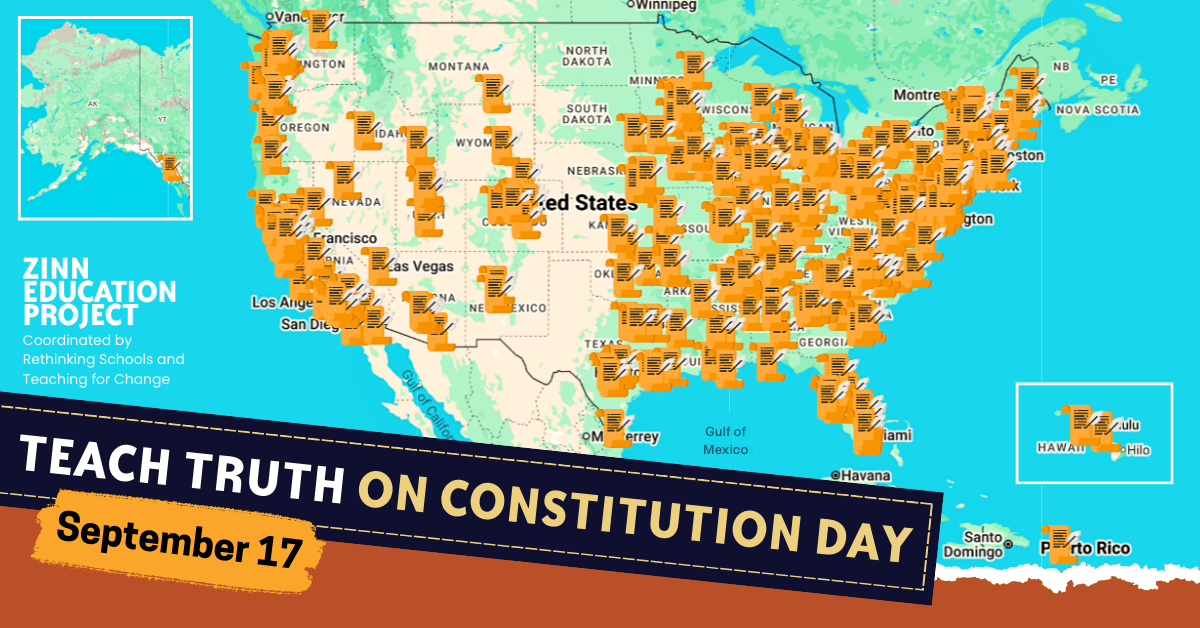
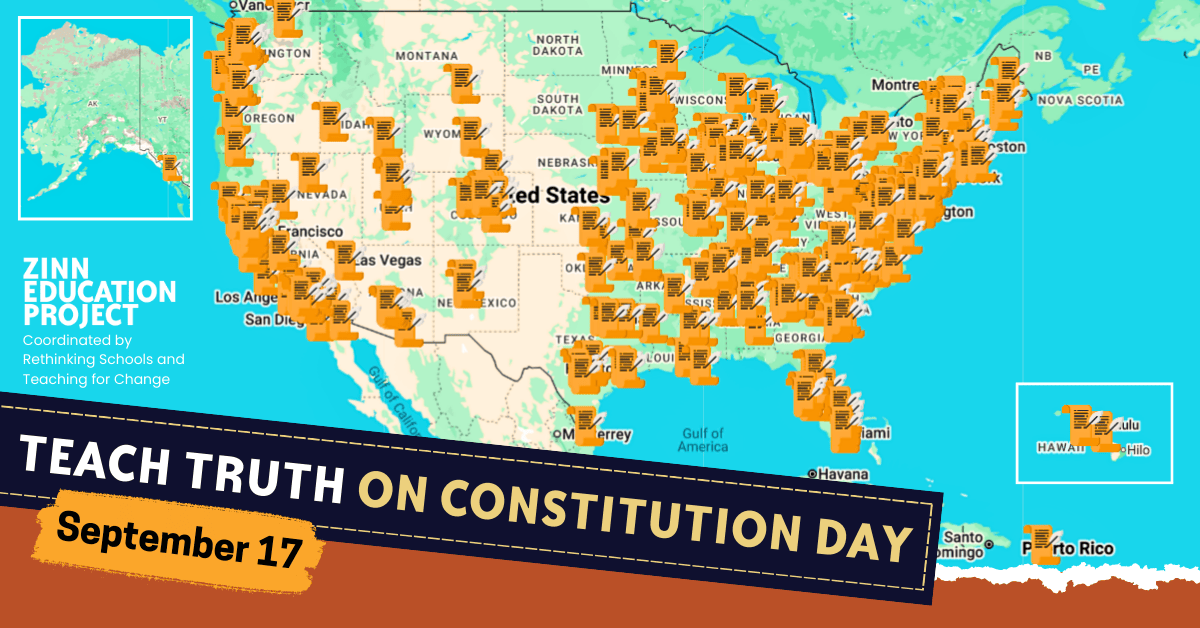
Close to 600 teachers signed up for Teach Truth on Constitution Day, using one or more of the five ways to participate.
We have heard from teachers in every state and territory except (so far) North Dakota. In preparation for the day, the National Education Association, the American Constitution Society, Zinn Education Project, and AFT’s Share My Lesson hosted a webinar with introductory remarks by free speech activitist Mary Beth Tinker (Tinker v. Des Moines).
The Zinn Education Project and the National Education Association are collecting stories from teachers. Find a few below and check back next week for many more.
Classroom Stories
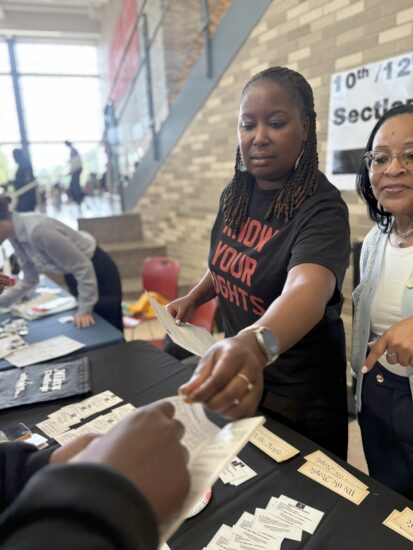
Dr. Shelina Warren. Photo by Dunbar HS staff or student.
Shelina Warren hosted a voter registration table and a Know Your Rights station at Dunbar High School in Washington, D.C. Days earlier, she had an op-ed published in Word in Black called “Teaching the Constitution — Truthfully — From a D.C. Classroom.” (Our thanks to Amy Poehler’s Smart Girls for sharing the op-ed on Instagram.) In it she said,
I teach constitutional law in Washington, D.C., a city that embodies the Constitution’s contradictions. My students can recite the preamble by heart and still ask a question no textbook fully answers: How can Congress overrule our local laws when D.C. has no voting members in Congress? That’s not a hypothetical. It’s their bus route, their block, their family. When the federal government takes over D.C. decision-making, it shows up on their streets and in our conversations.
. . . Here’s what I want them to carry out of Room 389 on Sept. 17: The Constitution belongs to you in all its complexity. You inherit both its promises and its unfinished business. Register if you can. Learn your rights. Ask hard questions about power. And then act on your block, in your school, at the polls, and, yes, in the halls of government that still don’t fully hear D.C.’s voice. Read in full.
In order to teach truth this Constitution Day, I had my civics and AP government classes complete a close reading of the Declaration of Independence and the preamble to the Constitution. We then defined the term “paradox.”
Students were then tasked with finding and discussing any paradoxes they saw in the espoused principles of these foundational documents and the actions of historic and contemporary figures and government entities. Topics such as treatment of Indigenous populations, slavery, sexism, immigration, foreign policy, oppression, taxation, and economic inequality came up in the discussion. We then transitioned to listening to excerpts of Frederick Douglass’ “The Meaning of July Fourth for the Negro” to continue to identify paradoxes and contradictions.
Students ultimately came away with a sense of critical hope, that it is up to us as the people to continue the fight to make aspirational rights and unmet promises a reality for everyone in America. This is a great springboard for our work around civil liberties, civil rights, and political participation in both classes.

Let me tell you — the primary sources in “Founding” Documents We Don’t Learn About were everything!
We started off taking a look at an excerpt from the Declaration of Independence and Thomas Jefferson and the principles of “life, liberty, and the pursuit of happiness.” Then we dove into these gems of primary source documents from the lesson and what the people had to say.
A fan favorite was a 1774 essay by Caesar Sarter where he says “. . . I need not point out the absurdity of your exertions for liberty, while you have slaves in your houses . . .” He’s essentially clocking white colonists who stood on their convictions about natural rights and their protests against Britain and how they were the same folks who enslaved Africans!
I highly recommend this lesson if you want to move beyond the typical founding documents, dive into the perspectives of those who were critical of the ideals of the founding and American “Revolution,” and engage your students!
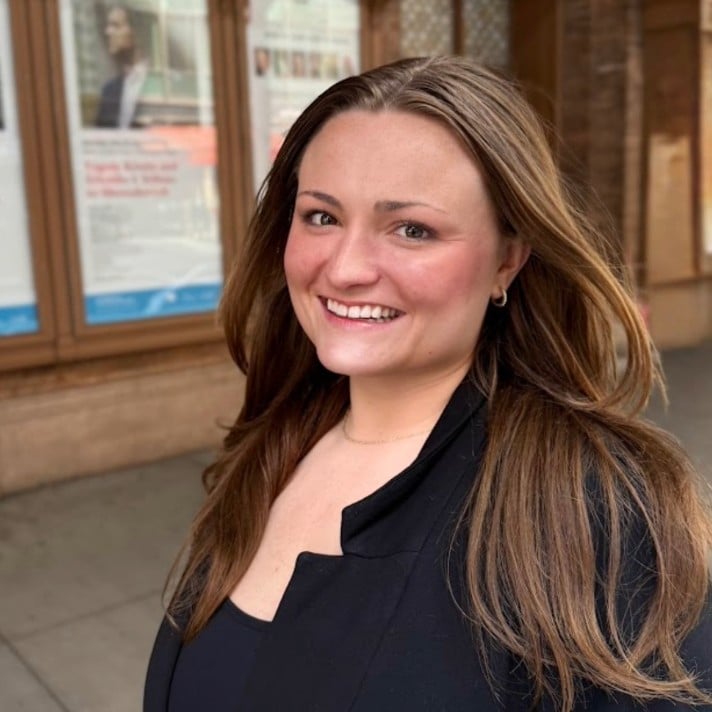
After five years of teaching high school social studies, I made the switch to middle school. With this exciting transition came a little chaos and a brand new curriculum. For Constitution Day, I knew I needed something different and accessible for my 7th graders, so I went to the Zinn Education Project for ideas. I adapted the lesson “We the People”: Whose Rights Does the Constitution Protect? and gave students their first “pop quiz” on their rights in the Constitution.
When they finished, most were confident they had aced it because to them, the rights listed seemed like no-brainers. But as the 50% (and lower) scores started rolling in, their confusion quickly turned to curiosity. We used that moment for open dialogue and a See, Think, Wonder about a graph showing which countries guarantee certain rights they assumed were part of U.S. citizenship.
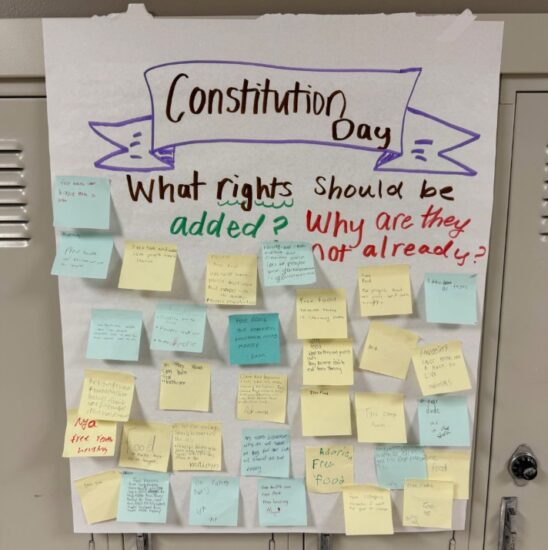
They were shocked and motivated. To close the lesson, students added sticky notes to a hallway poster, naming the right they believe should be added to the Constitution and why. The most common theme was food and housing, with many noting, “Other rights are useless if I am dying of hunger.”
The poster (below) now hangs in our hallway, serving as a reminder of student voice, reflection, and action.
I used the materials from “Founding” Documents We Don’t Learn About and the Ten Ways to Rethink the Constitution gallery walk activity for my 11th grade language arts class. Seeing the students engage with the documents from the 1700s and have meaningful conversations during the lesson was gratifying.
Students came up with poignant connections and questions to discuss with one another as they moved about the room. I love how the resource included a diversity of voices based on gender, race, and nationality. This resource helped students to see that more than just the framers of the Constitution were involved in establishing the nation.
— Katherine Green, High School Language Arts and English Teacher, St. Cloud, Minnesota
I used Bill Bigelow’s new lesson, Race, Class, and the Constitutional Convention.
I have to say, it’s the most engaged I’ve ever seen my students get about the Constitution, and it really has them thinking about who benefitted from the original document and what social groups had the most say and which voices were ignored.
I taught my first ever lesson on Constitution Day, using “We the People”: Whose Rights Does the Constitution Protect?
Students were amazed to learn that clean water, food security, and employment are not rights guaranteed by the U.S. Constitution — and that perhaps they should be!
Each student became a “constitutional scholar” on their specific right, they discussed and answered the questions, and then together we reviewed the answers.
We utilized segments of “We the People”: Whose Rights Does the Constitution Protect? during our mini-lesson on Constitution Day, September 17th.
Students watched a brief Black History Crash Course video by Clint Smith, providing an overview of the Constitution. Then they received the Student Chart where they could select which rights they felt were guaranteed in the Constitution. It was interesting to see how students navigated the chart, asking probing questions about what certain rights meant and other clarifying details before making their selections.
Not surprisingly, most students marked that almost all of the rights listed either should be, or were, already covered in the Constitution. This made the big reveal in our review of the actual answer sheet quite shocking for the group. Students were floored that essentials like clean water, housing, healthcare, and employment, among many others, were not guaranteed in the Constitution. The conversation that followed was both productive and powerful. Students explored many possible solutions to these clear and obvious gaps in our founding documents.
I teach 6th grade history and language arts in the high desert of Southern California. Fifth grade is supposed to include early American history, but my students rarely have knowledge of the Constitution and Bill of Rights, so my focus this year for Constitution Day was the Bill of Rights.
We started by discussing the Constitution as an imperfect, living, changing document and the idea of amendments as ‘fixes’ that had to be added — in the case of the Bill of Rights — right away. Understanding that laws change and that the right to liberty wasn’t part of the Constitution from the start were two of my major goals for this part of the lesson.
My students were particularly impressed by the 4th Amendment protections, which they were almost all completely unaware of. They thought that they were required to follow any directions from the police, and were relieved and pleased to hear that the police have limits (although we also discussed the fact that sometimes they don’t honor those, and ways to stay as safe as possible). We played the Do you Have a Right? game afterward, and they enjoyed that as well.
This was my first time doing this, and I plan to teach a similar lesson from now on for Constitution Day. My students need to understand more about the way our government was designed to work, and much more about their rights and responsibilities as people who live in this country to shape it into a better one.
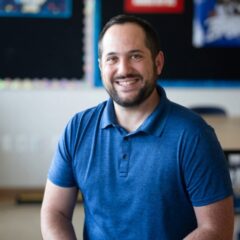 On Constitution Day, Ben Williams’ U.S. history class at School Without Walls (a D.C. public school) engaged in the lesson “We the People”: Whose Rights Does the Constitution Protect? by Jesse Hagopian. Some of the students’ insights and reflections were:
I was surprised by the sheer number of human necessities that were not rights. Clean drinking water, food, housing, just basic human needs that are not provided but the right to bear arms is. The priorities are a bit interesting.
I think a lot of the rights that are protected are more economically based. They’re more focused on protecting enterprise and business. Many rights for the people weren’t added until much later.
We do not have some rights that are considered human needs like food and clean drinking water.
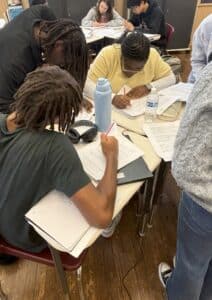 I learned a lot about how certain amendments came about. I also learned about amendments I didn’t know existed and that some I thought existed didn’t actually exist.
My main takeaways are that the United States still has a lot of work to do as a nation to guarantee its citizens well being, and that we need to play an active role in making sure our government upholds our rights.
According to our constitution, U.S. citizens are not explicitly entitled to what should be considered basic rights such as access to food, clean water, and affordable healthcare.
Today, many people are having their rights violated. This lesson helps us young people (as the future of the U.S.) to work towards solving these problems within our communities.
The Constitution is currently being heavily attacked and disassembled. We have to be aware of that.
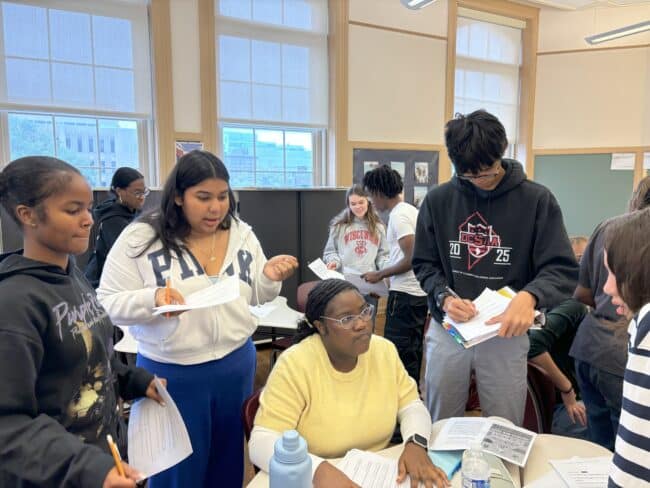
For Constitution Day, I did the Ten Ways to Rethink the Constitution Gallery Walk. I asked students to silently read as they walked around, and afterwards we gave them time to share their thoughts.
Students commented on how the Constitution was written in secret and how the system of checks and balances helped only certain groups of people. In addition, students felt it was important to know the Constitution to protect themselves. Others felt that the Constitution was an old document that should be continued to be revised and compared it to the Bible.
I appreciated this opportunity because students were able to share their thoughts about current events when this class was mostly about ancient history. Students are really afraid for their future, and I am too. Having direct evidence from the Constitution and showing the changes in the Constitution was helpful.
For Constitition Day, my virtual students and I engaged in a variety of activities, including playing a game with real Supreme Court cases called Do They Have A Right and watching a live talk with a Ben Franklin impersonator at the National Constitution Center. We also made class preambles to our own Class Constitutions to practice voting and understanding popular votes.
I discussed the Tinker v. Des Moines case and also brought in an interview with Mary Beth Tinker from a Retro Report resource. Students were polled on their thoughts about the Supreme Court decision in favor of the students and how the ruling was important for their own lives and decisions to stand up today. In conjunction with this lesson, 7th graders will also learn about the 1968 Chicano student uprising in California next week to analyze another case study of student rights!
For Constitution Day, I encouraged students to reflect on which rights they personally found most important and why, prompting them to consider how those rights influence their daily lives. This not only fostered critical thinking but also created a sense of ownership over the learning process, as students began to realize that the Constitution was more than just an old document; it directly impacts their freedoms and responsibilities as citizens.
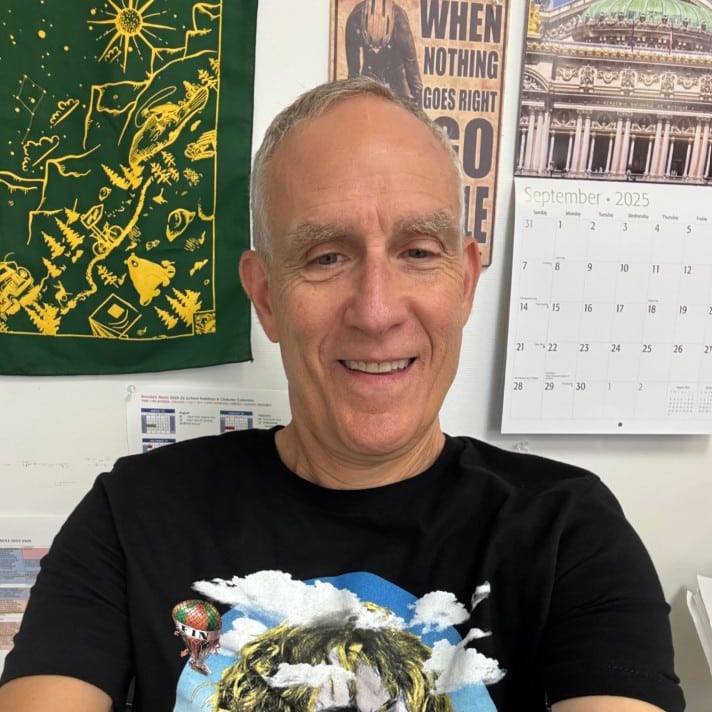
We started looking at the famous painting of the Declaration of Independence and who is and isn’t included. Then we began examining some alternative documents. We also read the story of Mumbet based on the true account of a Massachusetts woman who sued for her freedom.
I decided to link the celebration of Constitution Day with the Declaration of Independence because that’s what we’re studying now and the DOI is ripe for exploring racism, inequality, and the bitter reality of our country’s founding. The students were very engaged and this was probably the first time they’d encountered alternative documents. Having them so readily available on the Zinn Education Project website made it much easier for me.
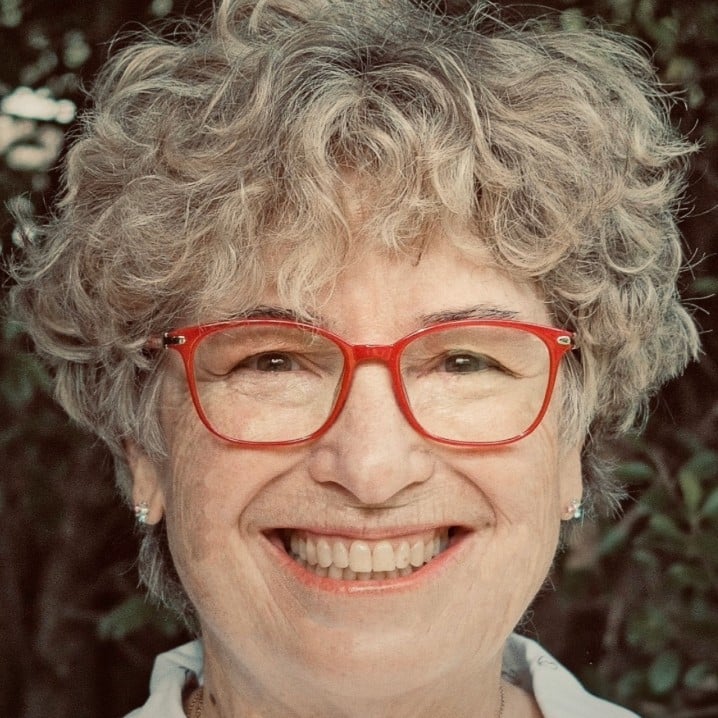
Most students in my class are over the age of 18 with a couple between the ages of 35–40. We did several lessons to help students understand the rule of law, and learned the six parts of the Constitution that create the rule of law: Order and Security, Legitimacy, Checks and Balances, Equal Application of the Law, Procedural Fairness, and Access to Justice. There was a great deal of discussion about how the rule of law is not always followed, which then led to discussion about what is constitutional and what is not constitutional?
We also watched parts of Ken Burns’ documentary The Central Park Five. Ultimately, students understood that the purpose of the constitution and rule of law was to treat all people equally regardless of wealth or race. Students recognized that they needed to share this information with their families, friends, and communities to ensure that everyone is treated fairly in the case of arrest or any other conflict.
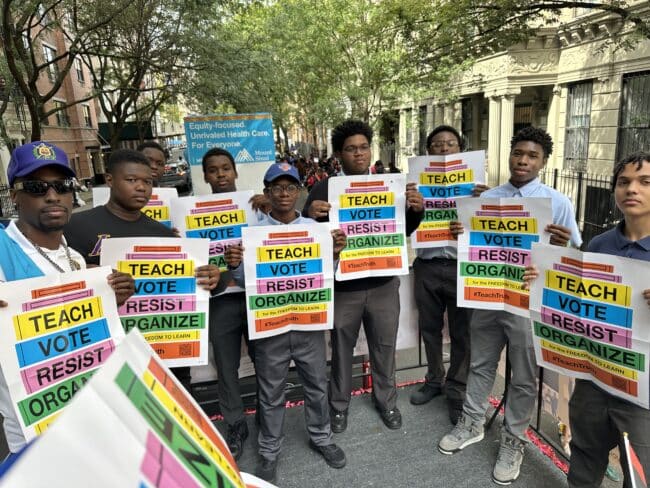
At Teach the Truth Constitution Day, we witnessed young people making connections: between clauses and lives, between rights guaranteed and rights still fought for. We saw teachers ignited with new resolve, parents inspired to engage more deeply in local governance, and neighbors recognizing that the Constitution is not some distant document — you live it when you stand up, when you organize, when you act.
Eagle Harlem’s participation did more than contribute to an event; it demonstrated what democracy looks like in motion: messy, beautiful, and powered by ordinary people daring to believe that truth matters. In that belief, we find our strength, and in that strength, we chart a path forward — one where every citizen knows the truth of their rights, the weight of their responsibilities, and the boundless possibility of our shared future.
When teachers signed up to Teach Truth on Constitution Day, they shared stories about their plans. Here are examples.
I will have the students go through some of the recent actions of the administration and using the language of the Constitution as a reference, they will decide in small groups whether the Constitution has been violated and why they think so or not. — middle school social studies teacher, Holly, Michigan
I’m incorporating it into my curriculum for my Constitutional Law class by centering our inquiry around the federal takover of D.C. by interviewing legal professionals and citizens and research what Home Rule and the Constitution says about it. — high school social studies teacher, Washington, D.C.
I will utilize resources from your site to help build mini lessons that I can do with my 4th graders throughout the day to help expand their understanding of the constitution and why it matters so much today in our current political and social climate. — elementary school teacher, Astoria, Oregon
Students will create a Gallery Walk for the hallway for students to read between classes. — high school language arts teacher, Tucson, Arizona
I teach the truth no matter what. Students often ask if something the U.S. president posted or said is lawful. I will take a few minutes to have students use their pocket Constitutions to look up what portion is in question. Then we discuss, and often debate, if the president is following the law. Students see so much on their social media feeds that I feel it is part of my job as an educator to help them find the truth. — high school social studies teacher, Houston, Texas
I plan on using excerpts of Frederick Douglass’ “What to the Slave is the Fourth of July” as a counter to dominant narratives about principles of American democracy contained in the Declaration of Independence and the Constitution. Students will be asked to reflect on how these principles and rights have been fought for, and where we continue to fall short as a society. — high school social studies teacher, Bothell, Washington
I purchase pocket editions of the Constitution for all my middle school students. My classes analyze news stories to find which part of the Constitution applies to them. Then they present. — high school social studies teacher, Gresham, Oregon
I will teach my six-year-old students about the preamble and how it was meant when written vs how we interpret it today. We will create our own amendment about the right to education. — elementary school teacher, Tulsa, Oklahoma
Students will participate in our campus Constitution Day discussion on the 1st and 1oth Amendments. Students will collaboratively examine the freedom of assembly in a “have protests changed over time” exercise. — high school teacher, Westfield, Massachusetts
As a teacher of African American History, my goal is to help students think critically, not just about now, but about how they can be part of shaping what “liberty and justice for all” actually looks like. — high school social studies teacher, Miami, Florida
I’m planning to use resources from NEA about understanding teachers’ rights and the rights of students. I’m also planning to use Bill Bigelow’s lesson on understanding the absences of class and race in the Constitution. We are also going to do a jigsaw with the Ten Ways to Rethink the Constitution. — teacher educator, Lincoln, Nebraska
I plan to use “Founding” Documents We Don’t Learn About by Mimi Eisen since it includes a lot of primary sources my 11 grade students can use to learn about different perspectives and people that were left out at the time of the creation of the Constitution and out of the mainstream narrative. — high school social studies teacher, San Juan, Puerto Rico
I plan to emphasize the 14th amendment’s impact on immigration rights — while acknowledging what the Constitution says about the power of the federal government vs. states AND the rights of women. — high school social studies teacher, La Grange, Illinois
On Constitution Day, our fifth graders will become history detectives! Equipped with clue cards and curious minds, students will set out on a Constitution Scavenger Hunt around the classroom. — elementary school librarian, San Francisco, California
When teaching about the Constitution, I help students see patterns of presidential overreach and the consequences when other branches of government fail to act as effective checks. This approach allows learners to connect the Constitution’s original intent with the realities of how power is exercised today, encouraging critical thinking about accountability, democracy, and civic responsibility. — university professor and school board member, Baton Rouge, Louisiana
I will teach about the Constitution because our students are paying close attention to what is happening with their families. They seek to connect the dots. — middle school social studies teacher, Tempe, Arizona
I will focus on the Bill of Rights and the process of amending the Constitution. Students will also explore comparisons between the tactics of this administration with 20th century authoritarian leaders. — high school social studies teacher, Birmingham, Alabama
As students ask me “wait, can they do that?,” we look at the Constitution together to figure out answers. As I am teaching govt, I have been struggling because it is hard to teach that “this is the way it works” when that is currently being completely ignored — but we look at what the Constitution and the laws SAY, and then look at what’s actually happening and compare. — high school social studies teacher, Springfield, Massachusetts
For Constitution Day, I plan to focus on empowering students with practical “Know Your Rights” resources, especially those related to student speech, privacy, and activism. Lessons will go beyond the traditional, whitewashed narrative by incorporating primary sources from historically excluded voices and works like A People’s History of the United States and Lies My Teacher Told Me. Students will explore how rights have been secured and expanded over time through movements for abolition, suffrage, civil rights, and modern activism. Activities such as debates, an interactive “Rights in Action” gallery, and tools like iCivics games and Crash Course videos will encourage critical thinking and engagement, helping students connect the Constitution’s history to their own lived experiences and responsibilities as citizens. — high school social studies and language arts teachers, Bruceton, Tennessee
I have invited the town mayor to come speak to students about the lawmaking process on the local level. In the past I’ve had my 8th graders study current cases before the Supreme Court and come up with their own ruling using evidence from the Constitution to support their findings. — middle school social studies teacher, Willits, California
The pocket Constitution and Know Your Rights resources by the ACLU are extremely important for many of the high school students I support as they protest in the communities they live in. — educational therapist, Alameda, California
I will honor the legacy of first peoples and engage in inquiry around the Great Law of Peace, that the U.S. Constitution was modeled after, with our 4th-grade students on Constitution Day. — curriculum specialist, Bronx, New York
I plan to kick off my unit on the American Revolution/ Constitution with the lesson “Founding” Documents We Don’t Learn About for my advanced classes and the Ten Ways to Rethink the Constitution gallery walk for my general classes. — high school social studies teacher, Fredericksburg, Virginia
In my a senior elective class on women and gender studies, we will discuss upcoming elections in our municipality and ways that 18 year-olds (and under) can get involved and refresh our knowledge on our rights as young people. — high school social studies teacher, Pittsburgh, Pennsylvania
My 4th-graders will listen to a panel of civil servants that will discuss how the Constitution shows up in the work they do and what “we the people” means to them contrasted to what it meant to the framers. The day before, I will be using the student chart from the lesson “We the People”: Whose Rights Does the Constitution Protect? to have them predict and then discover what rights are actually protected. — elementary teacher, Nashville, Tennessee
For Constitution Day, 3rd–5th grade students will engage in an interactive and educational three-week unit designed to help them understand the purpose, importance, and ongoing relevance of the U.S. Constitution. Students will explore key rights, including the freedom of speech, equal protection under the law, and the right to remain silent, learning that these rights apply to everyone and must be actively protected. The classroom activities will include reading and analyzing excerpts from the Constitution and the Bill of Rights, role-play scenarios to practice applying rights, a gallery walk featuring student-created posters inspired by historic civil rights campaigns, and a news-style interview project about adults’ knowledge of rights. — elementary teacher educator, Pensacola, Florida
I am planning a simple lesson for 1st-graders centered around what their rights are. — elementary teacher, Boulder, Colorado
I plan to use the Know Your Rights resources. — high school social studies teachers in Bristol, Connecticut; Greenacres, Florida; Indianapolis, Indiana; Pittsburg, Kansas; Portland, Maine; Raytown, Missouri; Jaffrey, New Hampshire; Binghamton, New York; Milwaukee, Wisconsin; and many more cities
I plan to use the Race, Class, and the Constitutional Convention lesson. — high school social studies teachers in Washington, D.C.; Ecorse, Michigan; Memphis; Tennessee; Smyrna, Tennessee; Atlantic City, New Jersey; and many more cities
Constitution Teaching Resources
Twitter
Google plus
LinkedIn