
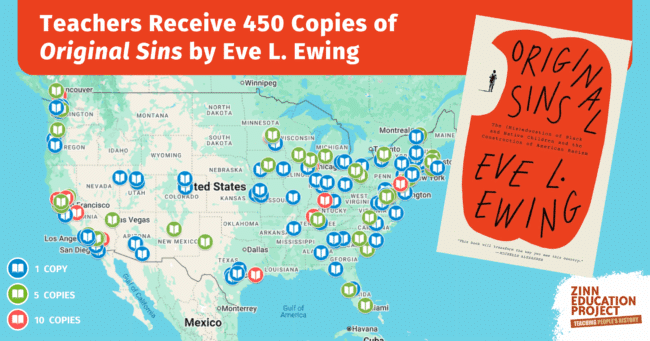
Thanks to generous donors, the Zinn Education Project gave 450 copies of Eve L. Ewing’s Original Sins: The (Mis)Education of Black and Native Children and the Construction of American Racism to teachers, teacher educators, school librarians, and curriculum specialists. As indicated on the color-coded map, educators received either 1 copy, 5 copies, or 10 copies for the classroom and/or teacher study groups.
Ewing will join the Zinn Education Project’s Teach the Black Freedom Struggle online series in September to discuss Original Sins and how the U.S. school system helps maintain racial inequality and social hierarchies.
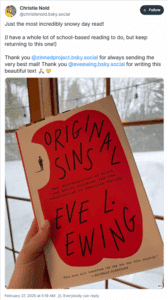
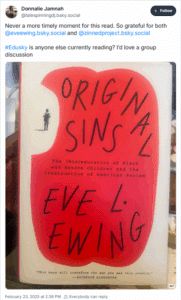
Teachers who received copies of the book shared their appreciation and teaching stories, including those below.
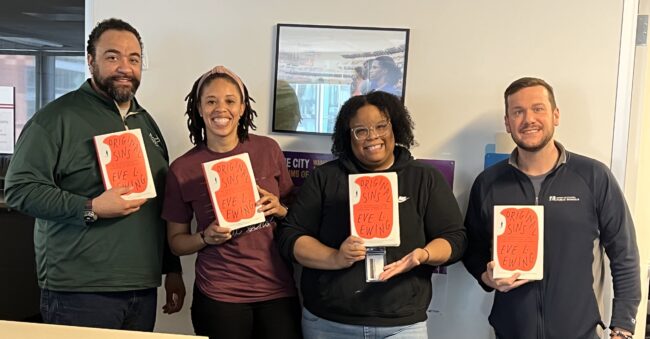
We love the book and will use it to inform our curriculum development. — D.C. Public Schools social studies team
This book was amazing. Not only did it help me understand more to make sense of our reality today, but I already used content from it in a keynote presentation I delivered to pre-service teachers. Our book club participants also learned so much. One member said, “There were many times that I was able to read something that shifted paradigms for me.” I’d love to host another study group with this book. — Lorena German, teacher, Tampa, Florida
Ewing concisely brings together a great deal of research in a highly readable manner. Her account deepened my understanding of U.S. history and revealed components that were new to me. — Cara Furman, teacher educator, New York, New York
I started a book club with freshmen and seniors reading Original Sins. Though we didn’t finish the book together, we met and discussed our annotations weekly. The conversations were collegiate. Students made connections to current events. The content is timely and eye opening. Times may seem unbelievable but after reading the history of education as laid out here, it all makes sense. Thank you for sending the extra copies! — Richard Brathwaite, high school social studies teacher, Brooklyn, New York
Original Sins by Eve Ewing has been more of a game changer than any other book that we’ve read. I don’t know if it’s a coincidence, but it really has made what’s going on right now, politically and in schools, seem so much more blatant. It stands out. This book is shouting everything that’s going on today.
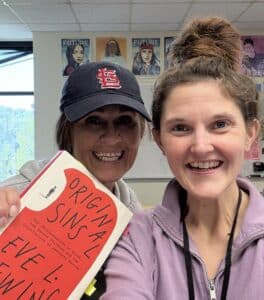
Tara Micham and Crystal Yakel-Kuntz
Every time I come to a Zinn Education Project class or program, I learn a lot. I become a better teacher and a better human. You are pushing us to new levels of understanding. For example, the whole Jefferson thing that Eve Ewing outlines, the three pillars, is just so glaring that I’m upset that I didn’t see it as she does before now. I appreciate that the Zinn Education Project supports educators in tackling these topics, feeding the population that hungers for understanding and never wavering from teaching truth even when the powers meant to protect are attacking. The struggles and work done by so many can’t be lost now. Just like Eve Ewing truly understands the assignment.
Our study group is reading and discussing Original Sins chapter by chapter. We discuss how it relates to what is happening now, how or if we are progressing, and what we can each do to make a change. We are all educators, but some of our titles are counselors, classroom teachers, and administrators. We all have a different role, but we all play a part. — Tara Micham, high school social studies teacher, Kansas City, Kansas
Original Sins deepened my understanding by giving clear and comprehensive history, including comparing what is typically taught and accepted to actual events that contradict common perceptions. Encountering so many examples inspired me to question everything more deeply and consider accepted “truths” through a more critical lens. — Kara Ketter, early childhood teacher, Fishers, Indiana
No matter whether it’s poetry or prose, Ewing is one of my favorite writers working today. In this book, she lays out the deliberate and purposeful mistreatment and miseducation of Black and Native children. As a public school educator, I found no cause to argue with her. I just underlined passage after passage after passage and tried, unsuccessfully, to think of a way to get my admin to read it. — Charles Ellenbogen, high school teacher, Cleveland, Ohio
 |
 |
Original Sins is already having an impact on our learning, mindsets, and teaching. Five members of our Teaching for Black Lives study group are reading the book so that we can brainstorm ways to use it with the full group. In our district’s curriculum, 6th graders learn about American Indian boarding schools, and Original Sins gives such full and honest context of how our country came to the idea of boarding schools.
Our hope is that more teachers will engage with sections of this book to have a more complete picture when they are teaching the unit to students. Being able to dig into the book has already pushed me to learn and unlearn so much about education and its historical impacts in the United States. I plan to continue looking for excerpts to use in our study group. Thanks so much for the amazing donation to help educators continue their learning journey! — Haileigh Mejia, middle school teacher, Iowa
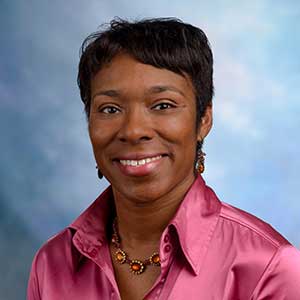 We used excerpts from Original Sins by Eve L. Ewing in my intro to urban education class and discussed the educational debt as well as the historical implications of racism and the U.S. education system.
Combined with other readings in the course, this book was an excellent addition.
I gave away the two extra books to my colleagues and encouraged them to incorporate the book or excerpts in their syllabi for the upcoming fall semester. — Chantee Earl, teacher educator, Atlanta, Georgia
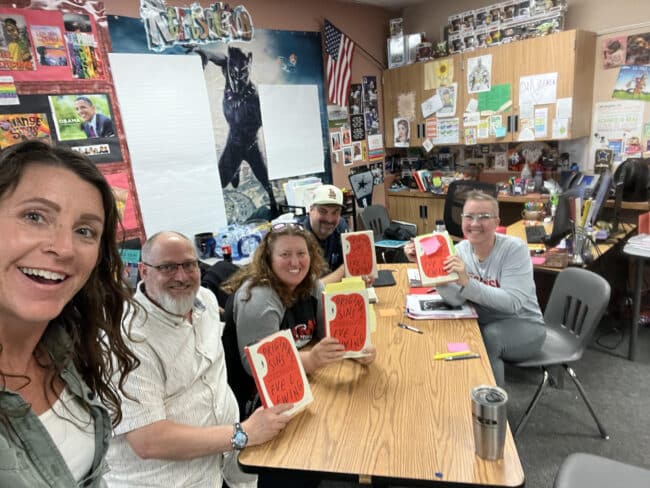
Our Teaching for Black Lives study group at Desert Springs Middle School in Desert Hot Springs, California (pictured above) read Original Sins by Eve Ewing. The book illuminated the insidious ways white supremacy is embedded in educational systems, from military-derived structures to carceral models that prioritize compliance over inquiry. While we read the entire book, the two chapters that stood out to our book club were 4 and 5. Chapter 4 generated good discussion for us in California as my peers never realized or were not taught that many Mexican families are indigenous to California. One member said, I wish there was a book on people native to California. I told him, you are reading it, friend. But as many of us are transplants to California, we were not taught California history growing up. This led us to consider how we can infuse those lessons in our middle school classrooms with context on the author. In addition to that, another member had a difficult time reading about his hero, Thomas Jefferson. He mentioned that history paints heroic views of our ancestors without showing the harm of their actions. — Carrie Mattern, middle school English teacher, Desert Hot Springs, California
I received more than one copy of Original Sins and distributed them to teachers. Teachers read the book and learned a great deal about the origins of education, and we discussed how it still impacts the education of Brown and Black youth. We decided as a group to develop a novice teacher reading group to educate and motivate budding teachers. — Veronica Jones, teacher, Clementon, New Jersey
 I really appreciated how Eve Ewing’s Original Sins broke down complicated ideas. For instance, Ewing’s detailed exploration of “race as a social construct” in the introductory chapter provided perhaps the most nuanced explanation of that concept that I have read, yet it was done so using language that could easily be understood by secondary and undergraduate students. I also appreciate how Ewing’s book builds understandings of racism and other forms of oppression as institutional and systemic without leaving the reader feeling hopeless about the possibility of change. As is the case with all of Ewing’s writing, this book is also beautifully, poetically written — another difficult feat when writing this kind of historical, non-fiction text.
I am a teacher educator, and as I am planning my syllabi for the Fall semester, I will be looking to Ewing’s book for readings. I have used Ewing’s Ghosts in the Schoolyard as a text in my undergraduate Educational Policy course, and I have seen how well students respond to her writing. I’m excited to have additional writing from her to draw from! I am also facilitating a Teaching for Black Lives study group with teachers at my own children’s elementary school, and I can envision this book being a great resource for those conversations.
I still need to finish the last couple of chapters, but once I do, I’ll be posting a five-star review on Goodreads. Thanks for the opportunity to read this fantastic book! — Laura Taylor, teacher educator, Memphis, Tennessee
I’ll be using Original Sins during the upcoming school year with other teacher educators and teachers to increase our understanding of how we can prevent miseducation of young people! — anonymous, Utah
I loved the history. It was very, very powerful. I have ear marked a few passages that I will use in my African American literature class during a unit that talks about education in America and bussing, using the short story “Recitatif” by Toni Morrison. I gave copies to administrators in my building and a couple of educators, and we read it and discussed it. — Jill Butler, high school teacher, Burlington, Massachusetts
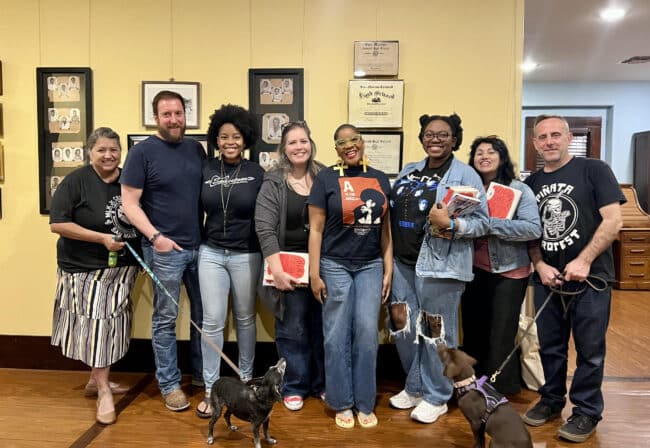
Teacher educator Skyller Walkes and colleagues in San Marcos, Texas, were thrilled to receive complimentary copies of Original Sins. They are part of a Teaching for Black Lives study group of eleven educators from San Marcos’ elementary schools, high schools, and state university. They meet monthly at the Calaboose African American History Museum’s Cephas House.
We established a book club with five staff members. After reading Original Sins we felt inspired to make our school a more responsive and compassionate place for our students of color. Specifically, we wanted to improve the way we interact with and educate immigrant students. Ultimately, we want all of our staff to better serve immigrant students from dozens of countries and countless situations, who otherwise can feel especially unwelcome, targeted, and criminalized. — Michael Rebne, high school teacher, Roeland Park, Kansas
Original Sins was a critical read for both myself and leaders in our district. Copies were shared with teacher leaders and they continue to be circulated. As we center racial justice work, it is necessary to deepen our understanding of the history behind the injustices we still see in school systems. — Kirsten Jensen, instructional coach, Bellingham, Washington
I appreciated Ewing’s analysis of the three pillars of institutional racism in schools and the history of this racism. I will use some of these ideas in my Asian American Studies class when I connect this to issues facing Asian Americans in education. — anonymous, teacher, Philadelphia, Pennsylvania
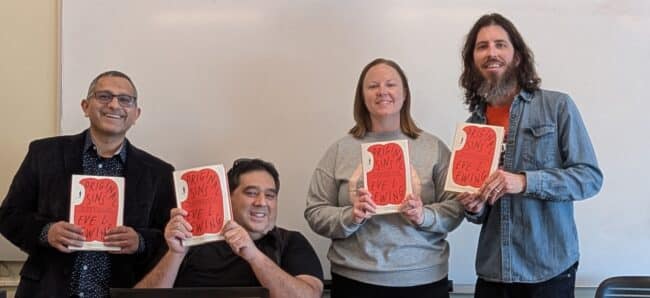
Nick DePascal (right) and colleagues.
I absolutely loved this book. It was so well written and organized. It was easy to follow, with copious examples and evidence, as well as just clear writing. I plan to use it at school and share my copy with colleagues, and also use portions to discuss when we read Trevor Noah and Ta-Nehisi Coates in my IB and AP classes, as it gives terrific contextual information and connects to our contemporary moment. I also recommended Original Sins to my colleagues in history, and I shared additional copies with peers and a professor in my grad school class on teacher education and social justice. — Nick DePascal, high school teacher, Albuquerque, New Mexico
I used Original Sins to facilitate a conversation about the relationship between education, schooling, and race. We loved putting it into conversation with Braiding Sweetgrass, too! — anonymous
 We invited Dr. Eve L. Ewing to speak at Carthage College. The event was sponsored by our Office of Equity and Inclusion. Dr. Ewing met with education students beforehand, gave a talk to students, faculty, staff, and the broader community, and then engaged in a Q&A session. It was spectacular!
We are reading Original Sins as a department and have opened an opportunity for our students to engage in a universal reading of the book. — Nina Weisling, teacher educator, Kenosha, Wisconsin
I will pass my copy of Original Sins on to my young history teacher colleagues with whom I had many, many discussions about white supremacy and education. My 8th grade history classes were based on two pillars: the theft of Native land and the theft of Black labor. I believe and hope that my former students will be able to read this book and nod along in agreement and knowledge rather than surprise. — Esther Honda, retired middle school teacher, San Francisco, California
Reading and learning are necessary measures to becoming and being an antiracist educator. Ewing performs a feat with Original Sins, creating a space where those new and not-so new to radical reading can have precise language, like the school-prison nexus, to discuss the infectious problems of racism in education, as well as lean into antidotes.
We will be using Original Sins for our Teaching for Black Lives study group and holding a book club within SURJ–KC Ed (Showing Up for Racial Justice – Kansas City Education) as a follow up to our Teach Truth event in June. — Crystal Yakel-Kuntz, high school teacher, Kansas City, Kansas
After receiving a free copy of Original Sins, elementary school teacher Sheila Myers started a summer book club in Philadelphia, Pennyslvania to discuss the book with friends and colleagues.
Original Sins influenced my understanding of the intersection of the oppression of colonization and imperialism. — anonymous, Tennessee
We are joining Chad Williams and the Michigan Education Association’s Center for Leadership and Learning (MEA teachers union), to design content for an Original Sins book study which will be available to teachers within our local union as well as state-wide. In September, we launched our online Original Sins book study for educators to explore the themes of the book and reflect on its implications for classroom practice. The response has been enthusiastic, and participants are already engaging in thoughtful reflections around equity, identity, and instructional transformation.
In addition, we’ve partnered with the University of Michigan Museum of Art to host a face-to-face Book Discussion and Educator Exchange. This partnership between classroom educators and the museum has created a powerful bridge between text, art, and pedagogy — allowing teachers to experience firsthand how interdisciplinary, justice-centered approaches can enhance student learning. — Noncy Fields, elementary school teacher, and Jake Engels, middle school social studies teacher, Canton, Michigan
Original Sins deepened my awareness of how education systems were deliberately structured to marginalize Black and Native children — not just through neglect, but through intentional policy and ideology. It furthered my understanding on how these forces continue to shape educational outcomes and societal narratives. This book will serve as a framework for pushing for more equitable systems. — anonymous, California
Original Sins provides a detailed history of race and racism in U.S. schools. Dr. Ewing draws a straight line from colonization to the present that deeply illustrates this. — Amanda Diaz, teacher educator, Fullerton, California
Original Sins has given me a new perspective on Thomas Jefferson and the role of the schools in perpetuating inequality. The lessons shared in this book should be part of every American’s education! — anonymous, New Jersey
This was so well researched and connected the experiences of Indigenous and Black students. I read it with a small group, and may use selections with students. — anonymous
Original Sins was an eye-opening read. I plan to share excerpts with colleagues. — anonymous, Missouri
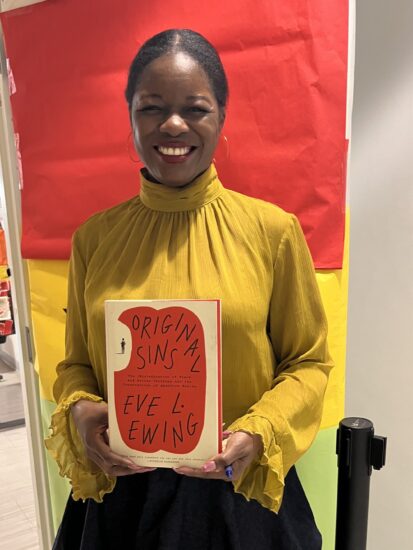 |
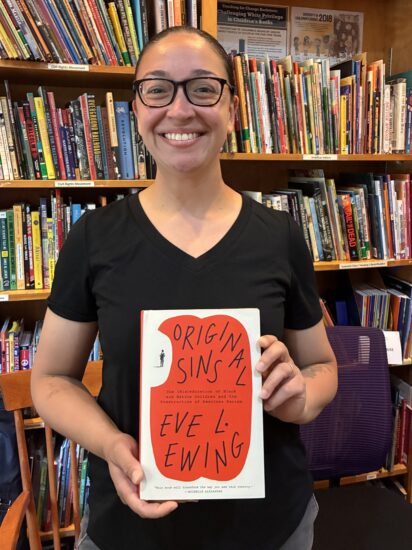 |
| Tamyka Morant, assistant principal, DC Public Schools | Makai Kellogg, early childhood educator, D.C. |
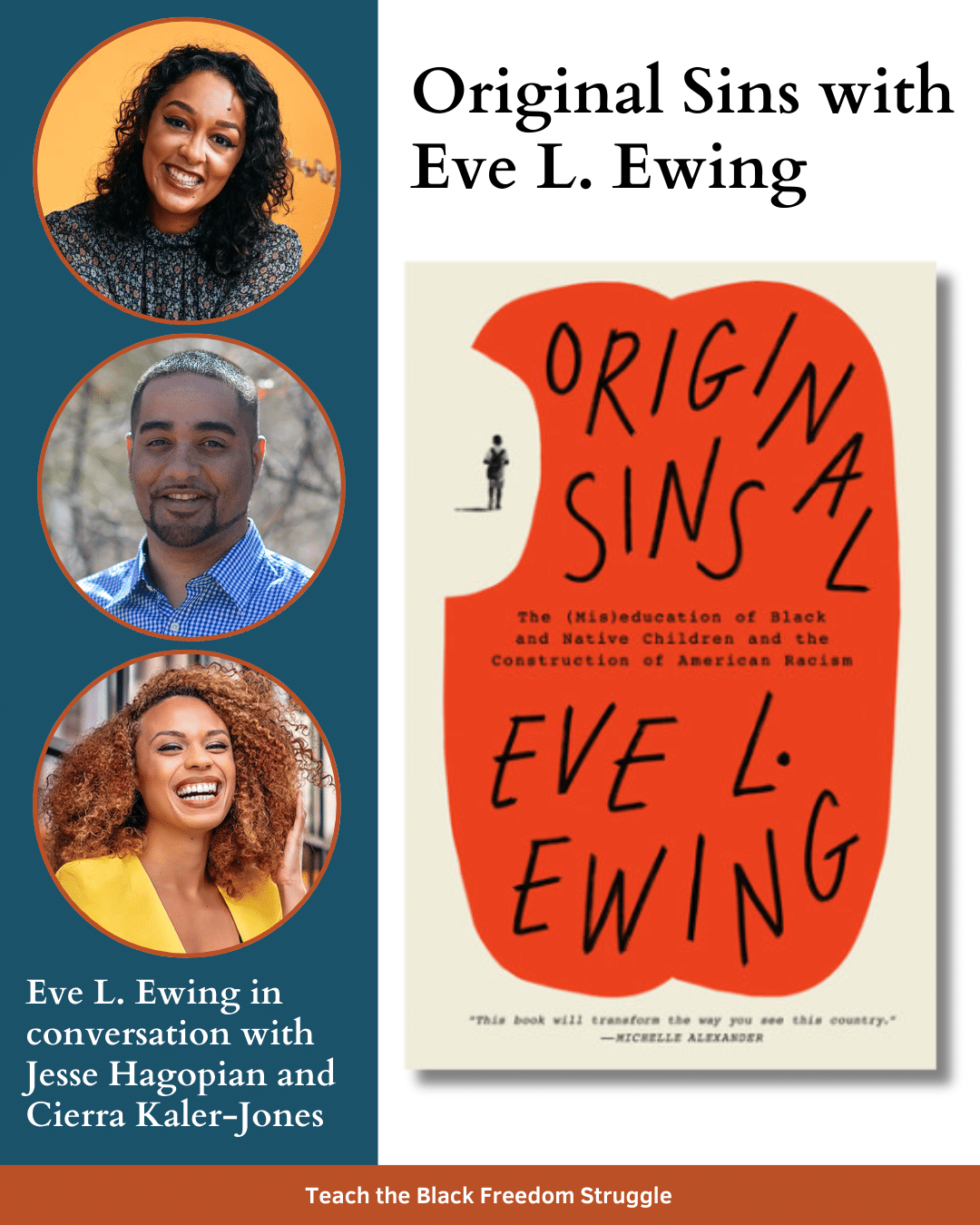
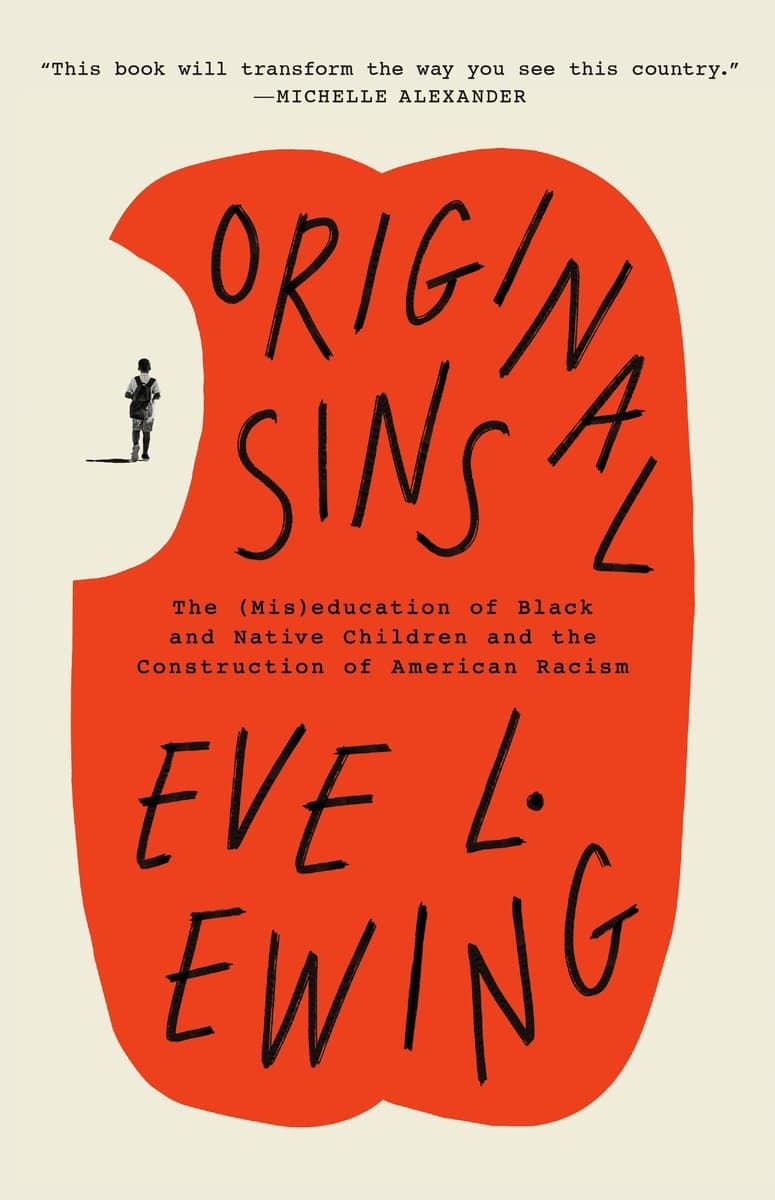
I cannot wait to use Eve Ewing’s book, Original Sins, with my literature and history students. Being fortunate enough to teach in both the ELA and Social Studies departments at my school, I look forward to discussiong the many literary and historical aspects of the book. Her writing style is so informative and simultaneously inviting, especially for teachers and students. Despite the repeated claims from those who oppose “Teaching Truth” that social justice educators are radicalizing students to hate America, Ewing’s use of primary source material will be incontrovertible evidence of how the process of Indigenous and Black folx being brought into the American project was fueled by white supremacist schools of thought.