

In the case of John T. Scopes v. the State of Tennessee, the defendant, Scopes, was found guilty of teaching about evolution — which was illegal in the state at the time. On July 21, 1925, Scopes, who was a county high school teacher, was fined $100 for violating Tennessee’s Butler Act, which banned the teaching of evolution in classrooms across the state.
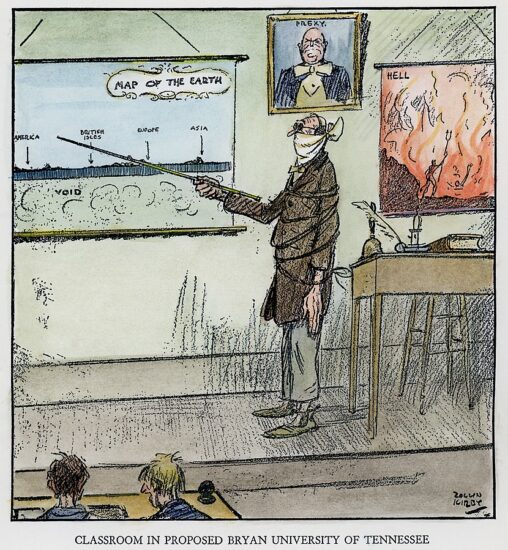
Scopes Trial cartoon by Rollin Kirby, entitled “Classroom in Proposed Bryan University of Tennessee.” Source: Public domain
As noted in an ACLU document related to the case,
The Scopes trial turned out to be one of the most sensational cases in 20th century America; it riveted public attention and made millions of Americans aware of the ACLU for the first time. Approximately 1,000 people and more than 100 newspapers packed the courtroom daily. The trial, which garnered extensive headline press coverage both nationally and internationally, was the first ever to be broadcasted live on the radio. A New York Times editorial pointed out that the case “gives scientific men a better opportunity than they have ever had to bring their teaching home to millions.” Read more.
The verdict was later overturned by the Tennessee Supreme Court on a technicality, though the Court did maintain the constitutionality of the Butler Act. In 1968, the U.S. Supreme Court ruled in Epperson v. Arkansas that such bans contravene the Establishment Clause of the First Amendment because their primary purpose is religious.
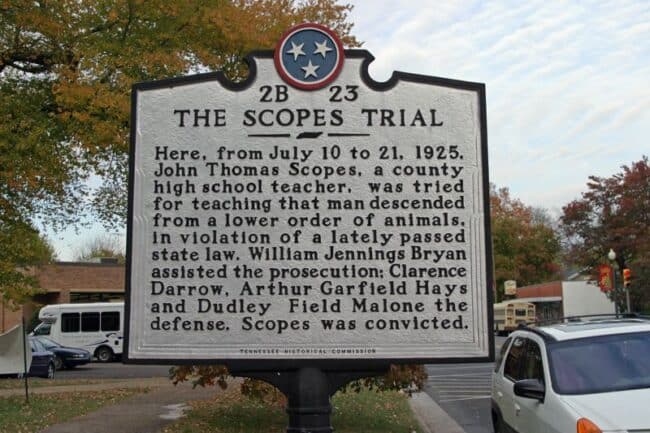
The Scopes Trial historical marker in Dayton, Tennessee. Photo taken by R. E. Smith. Source: Historical Marker Database
Additional Resources
Article
Considering History: The Scopes Monkey Trial and the History of Attacks on Educators by Ben Railton
Books
A Dangerous Idea: The Scopes Trial, the Original Fight over Science in Schools by Debbie Levy (Bloomsbury Children’s Books)
Keeping the Faith: God, Democracy, and the Trial That Riveted a Nation by Brenda Wineapple (Random House)








Twitter
Google plus
LinkedIn