
The Zinn Education Project promotes and supports the teaching of people’s history in classrooms across the country. The Zinn Education Project is coordinated by two non-profit organizations, Rethinking Schools and Teaching for Change, that have spent decades developing and providing social justice resources for teachers.
Since 2008, the Zinn Education Project has introduced students to a more accurate, complex, and engaging understanding of history than is found in traditional textbooks and curricula. With more than 160,000 people registered, and growing by more than 10,000 new registrants every year, the Zinn Education Project has become a leading resource for teachers and teacher educators.
The empowering potential of studying history is often lost in a textbook-driven trivial pursuit of names and dates. We believe that through taking a more engaging and more honest look at the past, we can help equip students — and all of us — with the analytical tools to make sense of and improve the world today. For a more complete description of our approach, read why teach people’s history.
Our website offers free, downloadable lessons and articles organized by theme, time period, and grade level. Based on the approach to history highlighted in Howard Zinn’s best-selling book A People’s History of the United States, our teaching materials emphasize the role of working people, women, people of color, and organized social movements in shaping history.
Our daily This Day in History posts highlight stories ignored in most textbooks and are shared on social media where we have more than 500,000 followers.
We also produce a regular If We Knew Our History column that features articles by teachers, journalists, and scholars that expose the myths told in corporate curricula and offer ideas for teaching outside the textbook.
We offer professional development workshops in collaboration with school districts, teacher unions, and at teacher conferences. To support teacher leaders, we host the Prentiss Charney Fellowship.
We have several campaigns including Teach Reconstruction, Teach Climate Justice, Teaching for Black Lives, and Abolish Columbus Day. In the spring of 2021, we launched a Teach Truth pledge and we have been active in campaigns to defend teaching honestly in the face of anti-CRT laws and book bans.
Read what teachers are saying about the Zinn Education Project.
Project Background
 In late 2007, former Boston University journalism student William Holtzman watched You Can’t Be Neutral on a Moving Train, the film about the life of historian, professor, and activist Howard Zinn. It brought back memories of attending Professor Zinn’s remarkable lectures at Boston University in the 1970s. He always marveled at how Zinn’s “people’s history” was so much more alive and accurate than the traditional history he received in high school.
After a successful career in technology, Holtzman wanted to bring Zinn’s work to a new generation of students. So he called Howard Zinn. “I contacted Howard and said that I wanted to honor him and extend the reach of his work,” said Holtzman. “Howard didn’t care about the former, but was very open to the latter.”
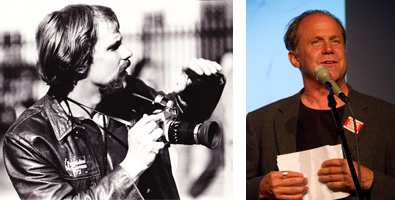
William Holtzman as a Boston University student and now.
Zinn introduced him to two non-profit organizations, Rethinking Schools and Teaching for Change. With the support of Holtzman and others, Rethinking Schools and Teaching for Change partnered to launch the Zinn Education Project in 2008.
Some 30 years after his exposure to Howard Zinn’s “people’s history,” the former Boston University student who initiated this project demonstrates that classroom experience can have a lifelong impact.
Donors
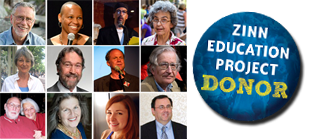 The primary support to sustain and build the Zinn Education Project comes from hundreds of individual donors each year. Visit our Donor page to learn why people have donated, making it possible for the Zinn Education Project to promote the teaching of people’s history. Learn the various ways you can donate to the Zinn Education Project on our Donate page.
Howard Zinn
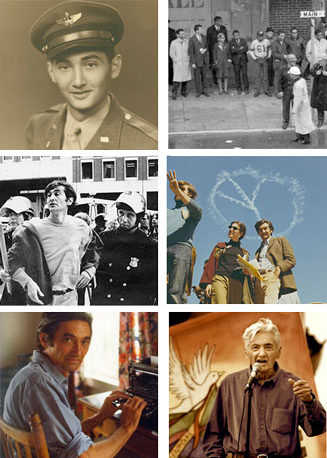 Howard Zinn was a historian, author, professor, playwright, and activist. His life’s work focused on a wide range of issues including race, class, war, and history, and touched the lives of countless people.
Zinn grew up in Brooklyn in a working-class, immigrant household. At 18 he became a shipyard worker and then joined the Air Force and flew bombing missions during World War II. These experiences helped shape his opposition to war and his strong belief in the importance of knowing history. Read more.
Coordinating Organizations
Rethinking Schools
 Launched in 1986, Rethinking Schools is a nonprofit publisher working for equity and justice in public schools and the broader society. Major projects include:
- Rethinking Schools, an award-winning quarterly magazine, unique among education publications. Edited by practicing and former pre-K-through-12 teachers with almost 200 years of combined classroom experience, it features a wide range of articles portraying some of this country’s finest social justice teaching. Other articles analyze the policies that help or hinder public education.
- A series of books, providing practical examples of how to integrate social justice education into social studies, history, language arts and mathematics. They are used widely by new as well as veteran teachers and in teacher education programs. Every Rethinking Schools book grows out of diverse schools and classrooms throughout the country.
- A website that offers a wealth of resources on teaching for equity and justice and making sense out of national education policy.
Teaching for Change
 Since 1989, Teaching for Change has provided teachers and parents with the tools to create schools where students learn to read, write, and change the world. Teaching for Change pursues its mission by:
- Providing free lessons and workshops for pre-K-through-12 teachers on Central America, the Civil Rights Movement, anti-bias education, and more.
- Coordinating the D.C. Area Educators for Social Justice, a network of social justice educators in the D.C. metro area with teacher-led working groups, institutes, workshops, and school-based resources.
- Vetting and promoting books for children and adults via SocialJusticeBooks.org in response to the wide diversity gap in children’s books and the publishing industry.